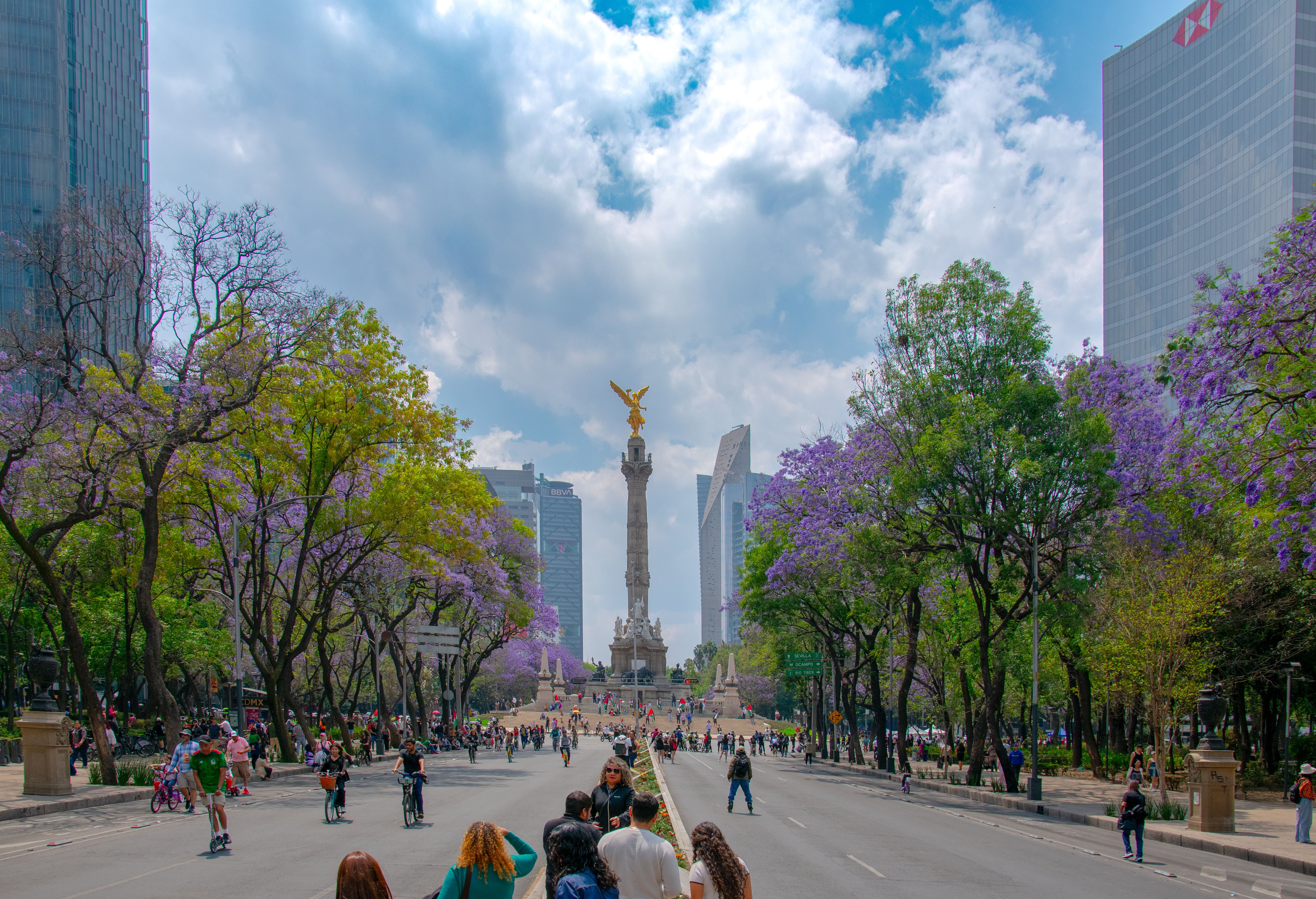
What 30 Years of Change Actually Taught Me
At A Glance
- Mexico City is very different from the 1980s and 1990s.
- Most visitors spend their time in well-traveled neighborhoods where violent crime is not the primary concern.
- Petty theft is a bigger risk than violent crime—use the same precautions you would in other major tourist cities.
- Uber, the Metro, and Metrobús make getting around easy
- Air quality has improved dramatically.
- At over 7,000 feet (2,100 m), altitude is more likely to affect visitors than they expect.
Thirty years ago, I would not have visited Mexico City.
I had heard too many stories about taxi robberies, world-record smog, overwhelming traffic, and transportation headaches. Even though I traveled to remote parts of Mexico—including the jungle covered ruins of Palenque—I avoided the capital. In my mind, Mexico City was simply too chaotic, too polluted, and too dangerous.
Then something interesting happened.
Over the past decade, I kept hearing a very different story, especially from younger travelers who had no memory of the city’s reputation in the 1980s and 1990s. Friends returned talking about the many museums, beautiful parks and tree-lined neighborhoods. Food writers couldn’t stop praising the dining scene. Eventually, curiosity won, and we added Mexico City to our itinerary.
What a surprise!
Uber worked easily and cheaply. The air was dramatically cleaner than photos from decades ago. We found dedicated bike lanes, wide pedestrian streets, and green spaces that felt more inviting than those in many large American cities. As we walked from Condesa into neighboring areas, we were struck by something unexpected: how clean everything was. On corner after corner, city workers were sweeping sidewalks and tending public spaces.

It wasn’t the Mexico City I thought I knew.
That doesn’t mean Mexico City is risk-free. No metropolitan area of more than 20 million people is. But in the areas that matter to tourists, serious crime is not a problem. Certainly there are areas in the country of Mexico that aren’t safe for travel but Mexico City is different. A headline about violence in one state does not necessarily describe daily life in another hundreds of miles away.
So what should travelers actually be concerned about in Mexico City?
For most visitors, violent crime is not the primary concern in the neighborhoods where tourists spend their time. Areas such as Condesa, Roma Norte, Polanco, Coyoacán, Chapultepec, and the major museum districts are generally well-traveled and popular with both residents and visitors. By recent homicide rates, Mexico City is better described as a mid-range large city than one of the world’s most dangerous capitals. Lower than some U.S. cities and higher than others.
The more realistic concern is petty theft.
Think pickpocketing, phone snatching, or leaving a handbag hanging on the back of a restaurant chair. In that sense, the precautions are much the same as those you’d take in Barcelona, Rome, Lisbon, Paris, or New York. Use a crossbody bag, keep your phone secure, and stay aware in crowded markets, festivals, and Metro stations.

Transportation has also changed dramatically. Years ago, taxi safety was one of the biggest concerns for visitors. Today, ride-share apps have made getting around remarkably easy. We used Uber extensively throughout our trip and never felt the need to rent a car. In fact, I would recommend strongly against renting one. Between heavy traffic, limited parking, and an excellent network of ride shares, Metro, and Metrobús lines, most visitors will find a car to be more of a burden than a benefit.
Air quality deserves a little perspective as well.
Mexico City still has pollution, but it no longer belongs in the same conversation as cities like Delhi or Beijing. A better comparison is Los Angeles—or even Denver—where a high-altitude basin surrounded by mountains can trap pollution during temperature inversions. Since the early 1990s, Mexico City has reduced particulate pollution by roughly 60 percent through cleaner fuels, stricter emissions standards, expanded public transportation, and other environmental initiatives.
If you have asthma, heart disease, or another respiratory condition, it’s still wise to check the daily Air Quality Index and schedule longer walks on clearer mornings. Fortunately, the months with the cleanest air—roughly November through January—also happen to be among the most pleasant times of year to visit.


The one issue I wouldn’t underestimate is altitude. At more than 7,000 feet above sea level, Mexico City sits higher than Denver. If you’re arriving from sea level, don’t be surprised if you feel more tired than usual, become short of breath climbing stairs, or develop a mild headache during your first day or two. Drink plenty of water, take it easy after you arrive, and save your longest sightseeing days until you’ve had a chance to adjust.

Travel is great for teaching us how much we don’t know about another country. Over the years my 30-year old narrative was reinforced by any remotely sensational headline about the country. Within two days of arrival I realized it needed a major update.
Worth Knowing: How Mexico City Brought Its Historic Center Back to Life
Just 25 years ago, many travelers avoided parts of the Historic Center after dark. Much of the area’s magnificent architecture had fallen into disrepair, streets were congested with traffic, and investment had largely disappeared. A turning point came in 2001, when the city partnered with businessman Carlos Slim to restore historic buildings, upgrade aging infrastructure, and encourage new businesses to return.
The next major change came in 2010, when Calle Madero—the city’s main route between the Zócalo and Bellas Artes—was closed to vehicles. Today, it is one of Latin America’s busiest pedestrian streets, lined with restored historic buildings, cafés, shops, and street performers. These early investments helped transform the Historic Center from a neighborhood many visitors avoided into one of Mexico City’s most popular places to explore.

If you’re still deciding whether to visit, read 👉12 Reasons Mexico City Should Be at the Top of Your Travel List.
Once you’ve chosen your travel dates, my 👉Mexico City Itinerary & Planning Guide will help you make the most of your visit with flexible 5-, 7-, and 10-day itineraries, neighborhood guides, transportation tips, and reservation advice.
Do you have safety concerns about visiting Mexico City? I’d be interested to hear them in the comments.
Leave a Reply